Soups & Stews
Slow Cooker Guinness Beef Stew Recipe
In this recipe
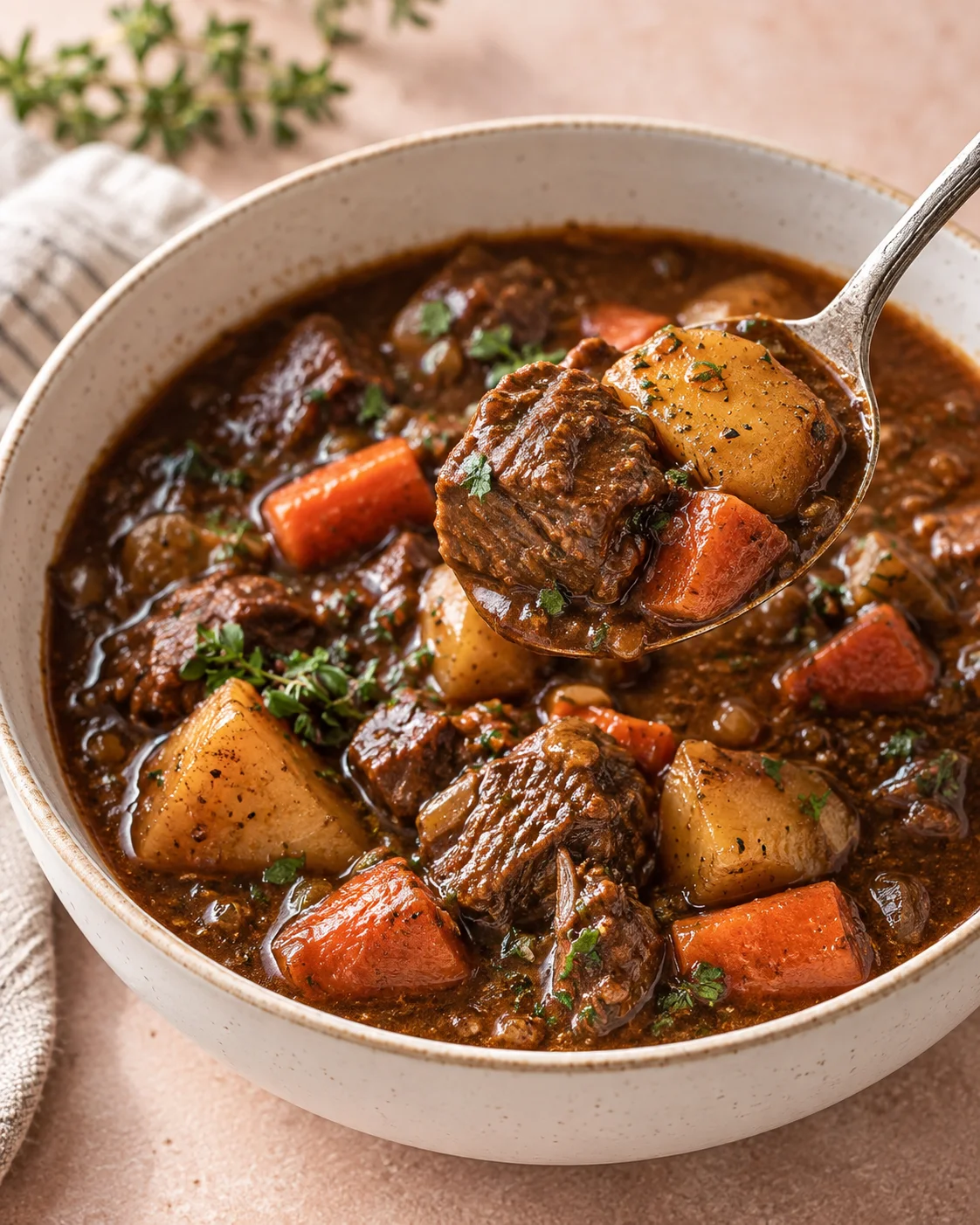
This slow cooker Guinness beef stew is hearty, rich, and made for a cozy supper on St. Patrick’s Day—or any other day. Beef cooks low and slow in a mouthwatering stout-flavored gravy until it is fall-apart tender, with carrots and potatoes settling into the same deeply savory pot. It is pure comfort in a bowl.
The slow-cooker method keeps the long cooking time organized: first build flavor on the stove by cooking the bacon, searing the beef, softening the onions and garlic, and deglazing with Guinness. Then the slow cooker takes over. The vegetables go in later so they become tender without turning mushy.
For a little more luck of the Irish, serve the stew with a loaf of Irish soda bread. Guinness chocolate cake, Irish porter cake, and homemade Irish cream can complete a St. Patrick’s Day meal, too. This is also a stew to make beyond the holiday whenever a rich, warming one-pot meal sounds right.
Traditional Irish stew is made with only mutton, onions, and potatoes. Guinness stew can be found in Irish pubs today, but the beef-and-stout version evolved after Irish immigrants came to the United States somewhere in the mid-1800s. This recipe is Irish inspired, with flavor taking priority over tradition. If you love French boeuf bourguignon, Belgian carbonnade flamande, or classic beef stew, you already know the appeal of a pot that simmers for hours and fills the home with savory smells.
Timing at a Glance
- Prep time
- 10 minutes
- Stovetop cook time
- 2 hours 25 minutes
- Slow cooker, high
- 2 hours on high, then 2 more hours on high (4 hours total on high)
- Slow cooker, low
- 4 hours on low, then 4 more hours on low (8 hours total on low)
The listed 10-minute prep time and 2-hour-25-minute cook time belong to the stovetop method. The slow-cooker method is separate: complete the stovetop flavor-building steps first, then use its two staged cooking periods for 4 hours total on high or 8 hours total on low.
Why You Will Love This Recipe
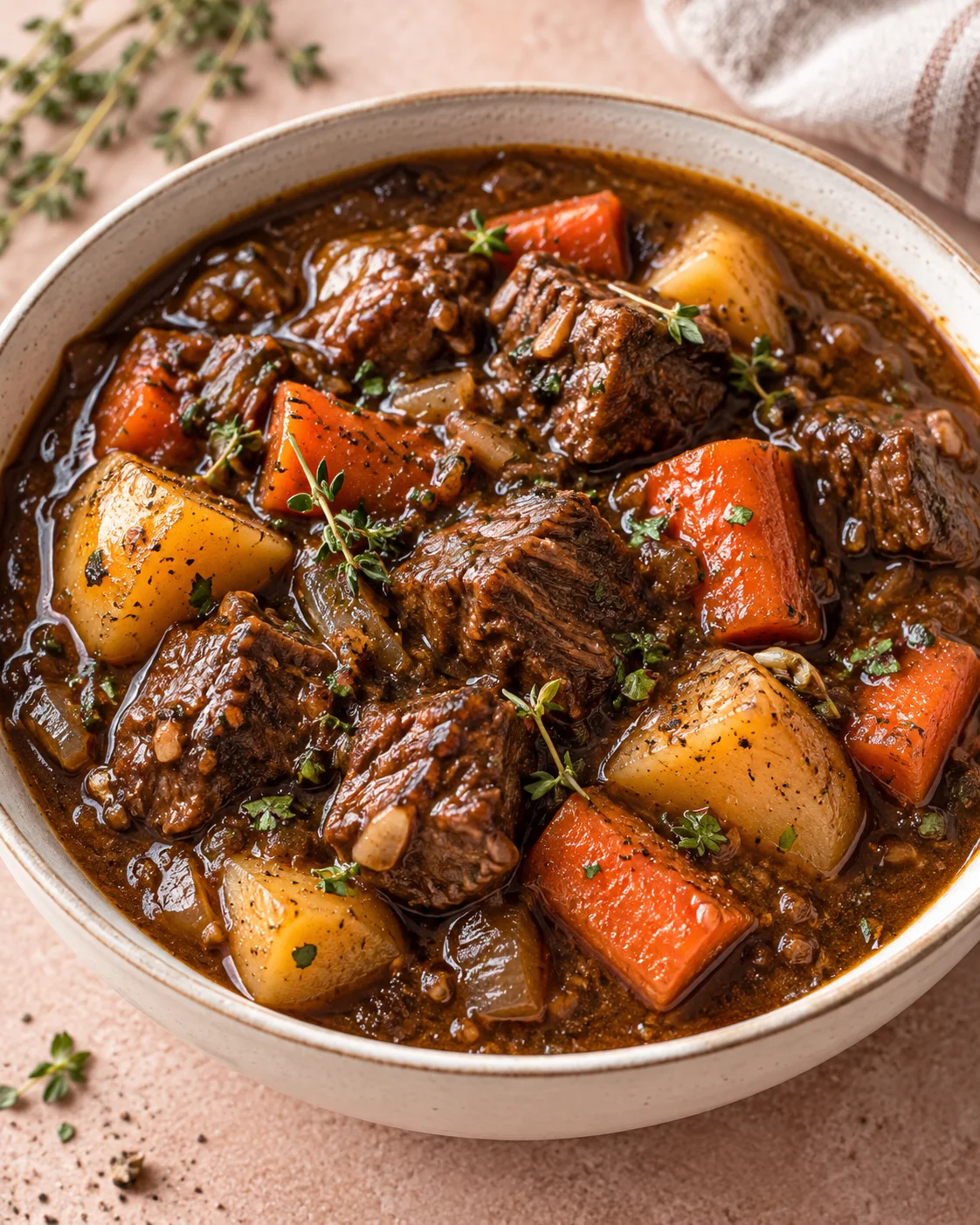
Guinness gives the gravy a deep, roasted wheat flavor and a stout character that makes the stew taste more layered than an ordinary beef stew. Bacon contributes both flavor and fat, and the beef is browned in that bacon fat so each piece has the chance to develop a dark crust before it begins the slow cook.
The flour and tomato paste are cooked briefly with the onions and garlic before the beer goes in. That step helps the paste become dark red and lets the wooden spoon loosen the browned bits from the bottom of the pot. Beef broth, Worcestershire sauce, brown sugar, and thyme then round out the gravy: the Worcestershire sauce adds umami, the thyme balances the flavors, and the brown sugar offsets stout’s bitterness.
Adding the carrots and potatoes after the first cooking stage is important. They spend enough time in the gravy to become cooked and tender, while the beef gets the longer time it needs to reach its fall-apart texture. The result is a slow cooker Guinness beef stew with a rich gravy, soft vegetables that still hold their shape, and beef that is ready to break apart with a spoon.
Ingredients and Ingredient Notes
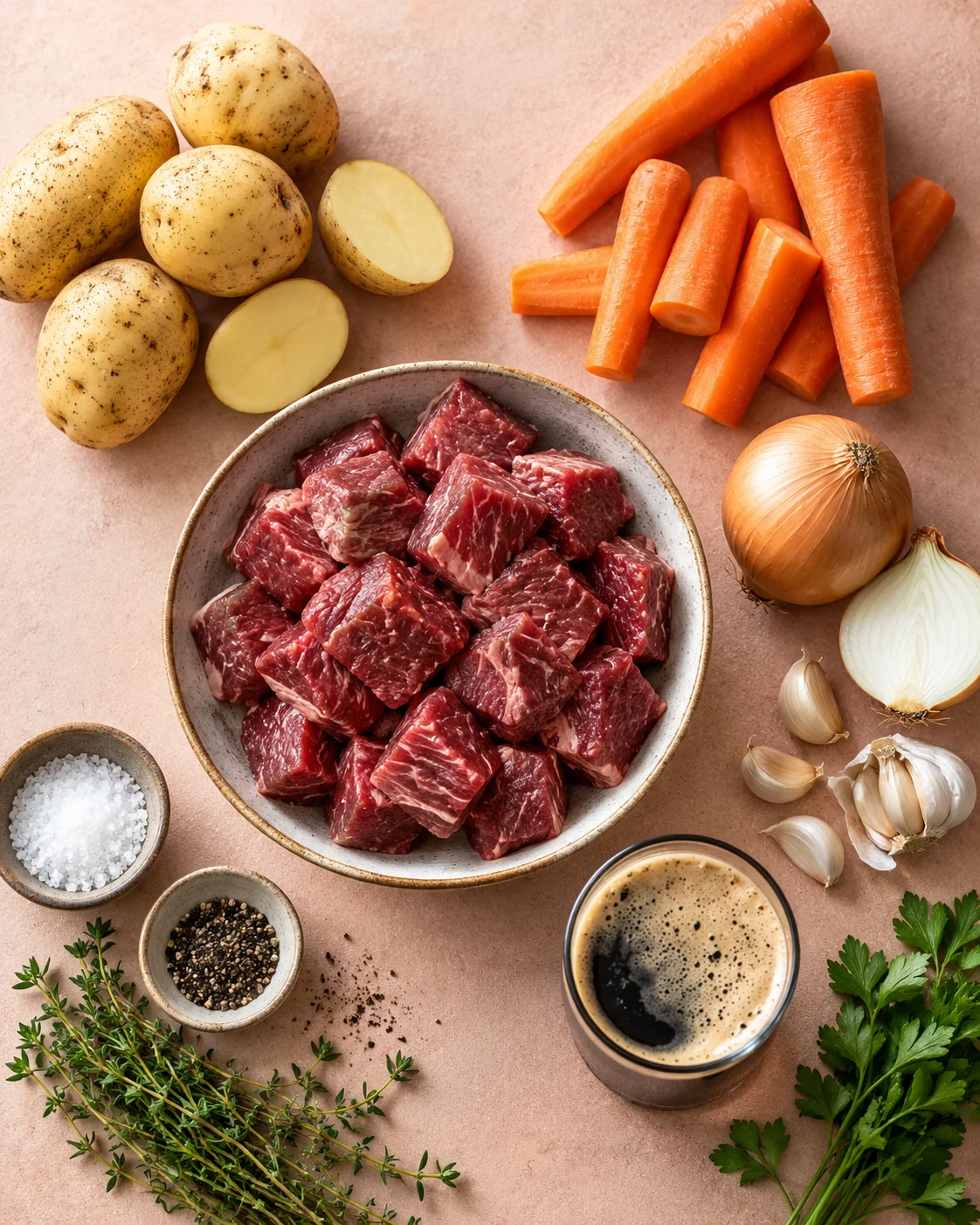
Gather the ingredients below before starting. The recipe uses a Dutch oven or large pot for the stovetop preparation, a wooden spoon for scraping up browned bits, and a slow cooker for the long cooking stage.
Ingredient notes
- Beef: Stew meat is convenient, or you can buy a chuck roast and cut it yourself. In Ireland, stews are traditionally made with lamb or mutton, but this version uses beef. Ask a butcher for stew meat if you want to cut down on prep time; it will most likely be chuck roast cut into 1-inch cubes.
- Guinness: Guinness is responsible for the stew’s richness. Its deep, roasted wheat flavor adds another dimension to the gravy. Guinness Extra Stout gives the stew an even deeper flavor.
- Bacon: The bacon brings flavor and fat. The beef is browned in the bacon fat, along with a little vegetable oil to get things started.
- Onions and garlic: These make the flavor base. The ingredient list calls for two large onions and three cloves of garlic.
- Carrots and potatoes: Yukon Gold or other waxy potatoes are the better fit for a long cook. Russets do not hold their shape as well when cooked for a long time.
- Beef broth: Homemade or store-bought broth works. Chicken broth can be used instead if you prefer.
- Flour: Flour thickens the stew slightly. If the finished gravy needs more body, the thickening options are listed below.
- Tomato paste: Cooking it with the flour adds sweetness and develops the paste’s color before the Guinness is added.
- Worcestershire sauce: A tablespoon adds a touch of umami to the stout gravy.
- Brown sugar: A small amount balances the bitterness of the stout. If the finished stew still tastes too bitter, the sugar can be increased.
- Thyme and parsley: Thyme balances the flavors during cooking, while parsley is stirred in at the end for freshness.
- Salt and pepper: Season the beef generously before browning, then taste the finished stew and adjust the seasoning as needed.
Exact ingredient list
- 1 teaspoon vegetable oil
- 4 slices thick-cut bacon, diced
- 3 pounds boneless chuck roast, cut into 1-inch pieces
- Salt and freshly ground pepper, to taste
- 2 large onions, sliced
- 3 cloves garlic, minced
- 2 tablespoons tomato paste
- 2 tablespoons flour
- 2 ½ cups Guinness beer
- 1 tablespoon Worcestershire sauce
- 1 tablespoon brown sugar
- 2 ½ cups beef broth
- 2 sprigs thyme
- 1 pound carrots, peeled and cut into 1-inch chunks
- 1 ½ pounds Yukon Gold potatoes, peeled and cut into 1-inch pieces
- ½ cup chopped parsley
How to Make Slow Cooker Guinness Beef Stew
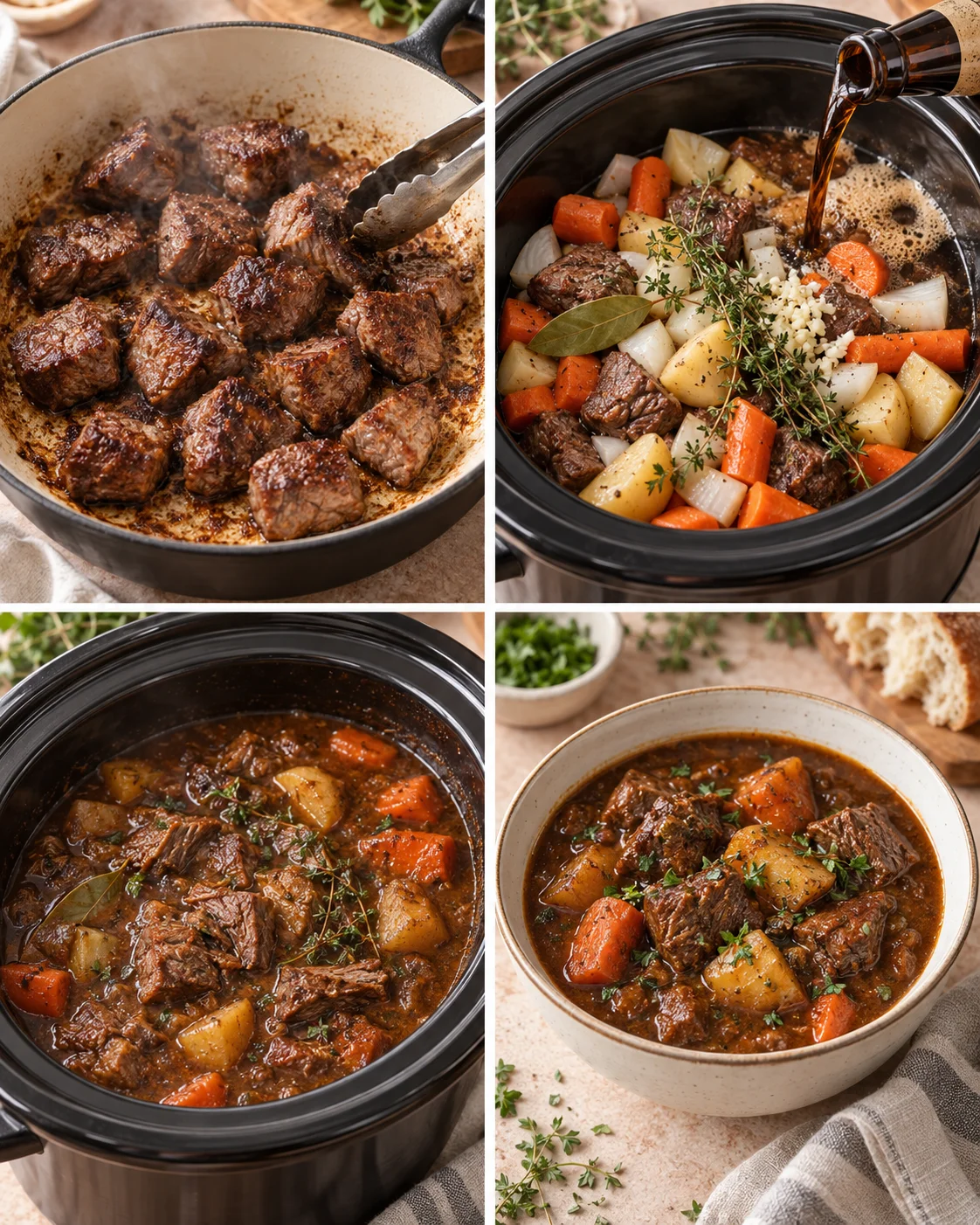
The slow cooker still needs a short stovetop preparation. Do not skip the bacon, searing, onion and garlic, flour, tomato paste, or Guinness deglazing steps: that is where the stew’s browned, rich flavor begins. These flavor-building steps are separate from the stovetop method’s 2-hour-25-minute cook-time label; after them, the slow cooker uses its own staged high or low timing. A skillet can be used for this preparation instead of a Dutch oven.
Stovetop Dutch oven method
- Cook the bacon. In a large Dutch oven or pot over medium-high heat, heat the vegetable oil. Add the diced bacon and cook until cooked through, about 4–5 minutes. Remove it with a slotted spoon and reserve it.
- Season and sear the beef. Season the beef generously with salt and pepper. Work in batches so the pot is not overcrowded, and brown the beef on all sides, about 1–2 minutes per side. Every piece should have contact with the hot pot so it can develop a dark crust. Remove the beef and reserve it with the bacon.
- Cook the onions and garlic. Turn the heat down to medium. If necessary, add a little more oil. Stir in the onions and sauté until they are beginning to brown, about 5 minutes. Add the garlic and cook until fragrant.
- Cook the flour and tomato paste. Stir in the flour and tomato paste until well combined. Cook for a minute or two, until the tomato paste turns a dark red color.
- Deglaze with Guinness. Pour in the Guinness, using a wooden spoon to scrape all the browned bits from the bottom of the pot.
- Build the broth. Stir in the beef broth, brown sugar, Worcestershire sauce, and a pinch of salt and pepper. Add the beef and bacon back into the pot, along with the thyme sprigs. Bring the mixture to a boil.
- Begin the beef cook. Once boiling, cover the pot and lower the heat to a simmer. Cook for 1 hour.
- Add the vegetables. Add the carrots and potatoes. Cover and continue cooking until the beef is falling-apart tender and the vegetables are cooked, about 1 more hour.
- Thicken if needed. If the stew is not thickened to the desired consistency, raise the heat to medium-high and bring it to a boil. Let it cook uncovered until thickened. You can also make a slurry from equal parts flour and cold water, beer, or broth, then pour it slowly into the stew while mixing well to prevent lumps. The stew needs to come to a boil to activate the starch.
- Finish. Discard the thyme sprigs. Taste the stew and adjust the salt and pepper if necessary. Stir in the chopped parsley and serve.
Slow cooker method
- Follow the stovetop preparation through deglazing: cook the bacon and reserve it, sear the seasoned beef in batches and reserve it with the bacon, sauté the onions until beginning to brown, cook the garlic until fragrant, stir in the flour and tomato paste, and deglaze with the Guinness. You can do these steps in a skillet instead of a Dutch oven.
- Transfer everything to the slow cooker. Add the beef broth, Worcestershire sauce, brown sugar, thyme, and a pinch of salt and pepper.
- Cook the beef stage for 2 hours on high or 4 hours on low.
- Add the carrots and potatoes. Cook for another 2 hours on high or another 4 hours on low, until the beef is fall-apart tender and the vegetables are cooked. Across these two slow-cooker stages, that is 4 hours total on high or 8 hours total on low.
- Stir in the parsley, adjust the seasoning, and serve.
The staged timing is the key difference in the slow cooker method. The beef starts cooking in the Guinness broth first, and the carrots and potatoes join later. That timing gives the meat its long, low cooking period while helping the vegetables stay tender rather than mushy.
Instant Pot method
The Instant Pot is another supported way to make the stew. Use its sauté function to cook the bacon and reserve it. Brown the beef in batches and reserve it with the bacon. Sauté the onions until lightly browned, then cook the garlic until fragrant. Stir in the flour and tomato paste, cooking until the paste color deepens, and deglaze with the beer.
Pour in the broth and add the Worcestershire sauce, brown sugar, thyme, and seasoning. Close the lid, set the valve to the “sealing” position, and cook on high for 30 minutes. Let the pressure release naturally.
Add the vegetables, cover, and set the Instant Pot to “sealing” again. Cook on high for 4 minutes. Release the pressure naturally, then turn the Instant Pot to sauté mode and simmer until the stew is thickened. Stir in the parsley and adjust the seasoning.
Tips and Troubleshooting
- Do not skip the sear. Brown every side of each piece of beef until it has a dark crust. The searing step is the secret to a rich, flavorful stew, and working in batches keeps the beef in contact with the hot pot instead of allowing the pieces to crowd and steam.
- Let the browned bits work for you. When the Guinness goes into the pot, scrape the bottom with the wooden spoon. Those browned bits become part of the stout-flavored gravy.
- Wait to add the vegetables. Adding them halfway through the cooking time helps them become tender without becoming mushy. This applies to the stovetop method and the slow cooker method.
- Fix a thin stew. First, bring the stew to a boil over medium-high heat and cook it uncovered until it thickens. If it needs more thickening, mix equal parts flour with cold water, beer, or broth. Pour the slurry in slowly while mixing well to avoid lumps, then bring the stew to a boil so the starch activates.
- Balance bitterness. Stout has a naturally bitter flavor. The brown sugar is there to balance it. If the finished stew is still too bitter for your taste, increase the amount of sugar.
- Use the doneness cues. The beef is ready when it is fall-apart tender, and the vegetables should be cooked. Taste for seasoning after the thyme is removed and before the parsley is stirred in.
Variations and Substitutions
The beef-and-stout combination is the main character here, but the recipe includes several supported options. Ask a butcher for stew meat instead of cutting a chuck roast yourself, or buy a chuck roast and cut it into 1-inch pieces. The recipe’s traditional context is different—mutton, onions, and potatoes are the ingredients in traditional Irish stew—but this version intentionally uses beef, bacon, stout, carrots, and the other ingredients listed above.
Guinness Extra Stout can be used for an even deeper flavor. Homemade or store-bought beef broth both work, and chicken broth can be used instead if you prefer. Choose Yukon Gold or another waxy potato for the long cook; russets are not a good fit because they do not hold their shape as well over extended cooking.
You can use a skillet for the bacon, beef, onion, garlic, flour, tomato paste, and Guinness preparation before transferring everything to the slow cooker. If you prefer pressure cooking, use the Instant Pot method with its separate 30-minute beef cook and 4-minute vegetable cook. These are alternate cooking methods for the same ingredient list, not additional ingredients or a different formula.
Storage, Make-Ahead, and Freezing
Guinness beef stew can be made up to 2 days ahead. Let it cool completely, then keep it covered in the refrigerator until you are ready to serve. Stews can taste even better the next day as the flavors rest.
For reheating, warm the stew on the stove over medium-low heat for about 15 minutes, or 15–20 minutes as needed, until hot. Add more broth or water if necessary.
The stew can be frozen, but potatoes can become mealy when frozen and thawed. For the best texture, skip adding the vegetables before freezing and add them when reheating. Freeze the rest of the stew in a large freezer bag for up to 3 months.
Serving Suggestions
Serve a bowl of Guinness beef stew with a crusty loaf or Irish soda bread so there is something to catch the rich gravy. For more sustenance, spoon it over rice or mashed potatoes. Colcannon is another good choice when you want to keep the Irish theme going.
A Guinness to drink alongside the stew keeps the stout theme going. If you are planning a full St. Patrick’s Day meal, Irish soda bread, Guinness chocolate cake, Irish porter cake, and homemade Irish cream all fit the menu.
Frequently Asked Questions
- Why is my Guinness stew bitter?
- Stouts are known for their bitterness. Brown sugar is included to bring sweetness into the stew and balance the overall flavor. If the stew is still too bitter for you, increase the amount of sugar.
- Can I make Guinness beef stew ahead of time?
- Yes. Make it up to 2 days ahead, let it cool completely, and refrigerate it covered until ready to serve. Reheat it on the stove over medium-low heat until hot.
- Can I freeze beef stew with potatoes?
- You can freeze the stew, but potatoes may become mealy after freezing and thawing. Skip the vegetables when freezing and add them when reheating. The rest of the stew can be frozen in a large freezer bag for up to 3 months.
- How do I reheat Guinness beef stew?
- Reheat it on the stove over medium-low heat for about 15 minutes, allowing 15–20 minutes as needed for the stew to become hot. Add more broth or water if necessary.
Nutrition
Nutrition information is per serving. The recipe makes 8 servings.
- Calories
- 541 kcal
- Carbohydrates
- 31 g
- Protein
- 39 g
- Fat
- 28 g
- Saturated Fat
- 12 g
- Trans Fat
- 1 g
- Cholesterol
- 129 mg
- Sodium
- 637 mg
- Potassium
- 1323 mg
- Fiber
- 4 g
- Sugar
- 7 g
- Vitamin A
- 9894 IU
- Vitamin C
- 30 mg
- Calcium
- 85 mg
- Iron
- 5 mg
A hearty, rich slow cooker beef stew with bacon, Guinness, carrots, and Yukon Gold potatoes cooked in a stout-flavored gravy until the beef is fall-apart tender, with stovetop and Instant Pot methods also included.
- Prep Time: 10 minutes
- Cook Time: 4 hours on high or 8 hours on low in the slow cooker; the stovetop method takes 2 hours 25 minutes
- Total Time: 43 minute
- Yield: 8 servings 1x
- Category: Main Course
- Cuisine: Irish-inspired
Ingredients
- 1 teaspoon vegetable oil
- 4 slices thick-cut bacon, diced
- 3 pounds boneless chuck roast, cut into 1-inch pieces
- Salt and freshly ground pepper, to taste
- 2 large onions, sliced
- 3 cloves garlic, minced
- 2 tablespoons tomato paste
- 2 tablespoons flour
- 2 ½ cups Guinness beer
- 1 tablespoon Worcestershire sauce
- 1 tablespoon brown sugar
- 2 ½ cups beef broth
- 2 sprigs thyme
- 1 pound carrots, peeled and cut into 1-inch chunks
- 1 ½ pounds Yukon Gold potatoes, peeled and cut into 1-inch pieces
- ½ cup chopped parsley
Instructions
- Over medium-high heat, heat the oil in a large Dutch oven or pot. Add the diced bacon and cook until cooked through, about 4 to 5 minutes. Remove it with a slotted spoon and reserve.
- Season the beef generously with salt and pepper. Working in batches so the pot is not overcrowded, brown the beef on all sides, about 1 to 2 minutes per side. Reserve it with the bacon.
- Turn the heat down to medium. Add a little more oil if necessary, then sauté the onions until beginning to brown, about 5 minutes. Add the garlic and cook until fragrant.
- Stir in the flour and tomato paste and cook for a minute or two, until the paste turns a dark red color. Pour in the Guinness, using a wooden spoon to scrape all the browned bits from the bottom of the pot.
- Stir in the beef broth, brown sugar, Worcestershire sauce, and a pinch of salt and pepper. Add the beef and bacon back into the pot, plus the thyme sprigs. Bring to a boil.
- Once boiling, cover and lower the heat to a simmer. Cook for 1 hour.
- Add the carrots and potatoes. Cover and continue cooking until the beef is falling-apart tender and the vegetables are cooked, about 1 more hour.
- If the stew is not thickened to the desired consistency, bring it to a boil over medium-high heat and cook uncovered until thickened, or slowly add a slurry made from equal parts flour and cold water, beer, or broth. Bring the stew to a boil to activate the starch.
- Discard the thyme sprigs and taste for seasoning, adjusting salt and pepper if necessary. Stir in the chopped parsley and serve.
- For the slow cooker method, complete the bacon, beef, onion, garlic, flour, tomato paste, and Guinness steps on the stove, then transfer everything to the slow cooker. Add the beef broth, Worcestershire sauce, brown sugar, thyme, and seasoning. Cook for 2 hours on high or 4 hours on low, then add the carrots and potatoes and cook for another 2 hours on high or 4 hours on low. Stir in parsley, adjust seasoning, and serve.
- For the Instant Pot method, use sauté mode for the bacon, beef, onions, garlic, flour, tomato paste, and Guinness. Add the broth, Worcestershire sauce, brown sugar, thyme, and seasoning. Cook on high pressure for 30 minutes and let the pressure release naturally. Add the vegetables, cook on high pressure for 4 minutes, release pressure naturally, then use sauté mode to simmer until thickened. Stir in parsley and adjust seasoning.
Notes
The source recipe card lists 10 minutes of prep and 2 hours 25 minutes of stovetop cook time., The slow cooker method uses two stages: 2 hours on high or 4 hours on low before adding the vegetables, then another 2 hours on high or 4 hours on low., The source does not specify a total time or serving-size amount beyond 8 servings.
Nutrition
- Calories: 541 kcal per serving
- Fat: 28 g per serving
- Carbohydrates: 31 g per serving
- Protein: 39 g per serving
Keep exploring
More from the recipe collection

Soups & Stews
The Ultimate Creamy One-Pot Potato Soup

Soups & Stews
Marry Me Chicken Soup Recipe (Stovetop or Crockpot)

Soups & Stews
One Pot Creamy Vegetable Soup